The audio below was generated by ‘NotebookLM’.
March 26
All existence drifts through the emptiness of space to begin with.
Inside the plane heading to Amsterdam
The plane is flying over the Gobi Desert.
Getting to Svalbard required three flights. There was no direct flight to Oslo, so I had to fly from Incheon to Amsterdam, Amsterdam to Oslo, and Oslo to Longyearbyen — three flights in total.
I wanted to just fall asleep and forget about it, but the desert sky wouldn’t let me. The turbulence refused to settle, shaking the plane without rest. Statistically, nothing terrible would happen, but every time it shook violently, I felt a helpless thought creep in: ‘I could actually die here.’
All I could do was fasten my seatbelt. Inside that plane, I was searching for something to hold onto. How fragile a being I am. Encased in an aircraft carrying enormous momentum, I felt infinitely small.
34,000 feet above the desert — a place where a human body alone could never exist. I am present here, and yet absent.
Even with the window shade fully open, no boundary, no line, no point is visible — only pitch-dark light reveals the presence of absence. In this place where even a frame of reference has been lost, only turbulence reminds me that I exist.
Then is my semicircular canal the only proof of my existence? If I had no semicircular canals, would I exist in this plane at all?
After passing the Gobi, the sun had already risen over Korea, but the plane was still crossing an endless night. Someone’s midnight. Countless people’s midnights passed beneath us. Outside the window, starlight and someone’s city lights blurred together.
Schiphol Airport and the Lead Pouch
Short layover, and since I’d been seated near the back, I had to run. I’d brought a generous supply of Super 8 film (color negative 50D, 200T, 500T — one roll each — plus black-and-white and Ektachrome, six rolls in all) and stored them in a lead pouch to shield them from X-rays during security screening.
I’d heard that requesting hand inspection at airports can be difficult, so I’d prepared the pouch in advance. After passing through the CT scanner at Incheon with the film inside the lead pouch, I asked ChatGPT whether it had actually been safe.
Damn.
Apparently, depending on the radiation dose, the lead pouch doesn’t provide complete protection. The CT scanner beam had likely already cut through my film. Before the film could even capture the light of Svalbard, it had already captured X-rays. What’s done is done. The scars of regret will probably show up as unintended double exposures.
From then on, I resolved to just muster the courage and ask for hand inspection. I took four more flights after that, and every time I asked, the staff kindly obliged. The only thing that needed extra screening was the empty lead pouch itself.
With only an hour for the connection, I sprinted toward the gate. The dreary sky over a dim, early-morning airport only heightened my anxiety. I barely made it and boarded last.
Once we climbed above the gloomy Amsterdam clouds, the sky was clear again. Our moods rise and fall with the weather. But above the clouds, everywhere is clear.
Heading to Oslo.
The Blank Receipt
I arrived in Oslo in the morning. The central station was closer than I’d expected. Since I’d arrived early, I left my luggage at the hotel and wandered through Oslo. Stepping out of the hotel, I naturally called home, as if I were just some passerby. It was a weekday morning, but the streets of Oslo were quiet.


“I’ve always wanted to see the Sognefjord.”
My mom asked how I was doing over the phone. She studied geography. When I was young, she’d tell me stories about field trips, about erosion and sedimentation, and explain how the columnar joints of the Hantangang River were formed.
There were certain geographical phenomena she’d always wanted to see in person, and fjords were one of them.
”Dad says make sure you know where the police station is.”
My dad worried about me going so far alone. After the brief phone call, I went back to being a passerby.


Traffic lights with two red signals lit at once. People pressing some unidentifiable box attached to the signal poles as if it were the most natural thing in the world.
Slightly different rules — it felt like stepping into a parallel universe. Everyone was at ease except me. To become a convincing passerby, I had to act on instinct. I tapped the box on the side, on top — nothing happened.
The only surface left was the bottom, and reaching under something I couldn’t see felt daunting. ‘What if there’s something under there…’ I pressed it without even knowing what the button looked like. Why would anyone put a button on the underside?
It felt like a test of some kind.
The History of Prisma Daps | PrismaTibro
Some of our earliest push buttons for pedestrians were called TS-9XX. Today, they are called Prisma Daps, Digital Acoustic Pedestrian Signal.
https://www.prismatibro.se/en/the-history-of-prisma-daps/#
Looking it up, it turned out to be the product above. The side panel is also a button, apparently. The textured patterns on the other sides were Braille indicating the layout of the crosswalk.
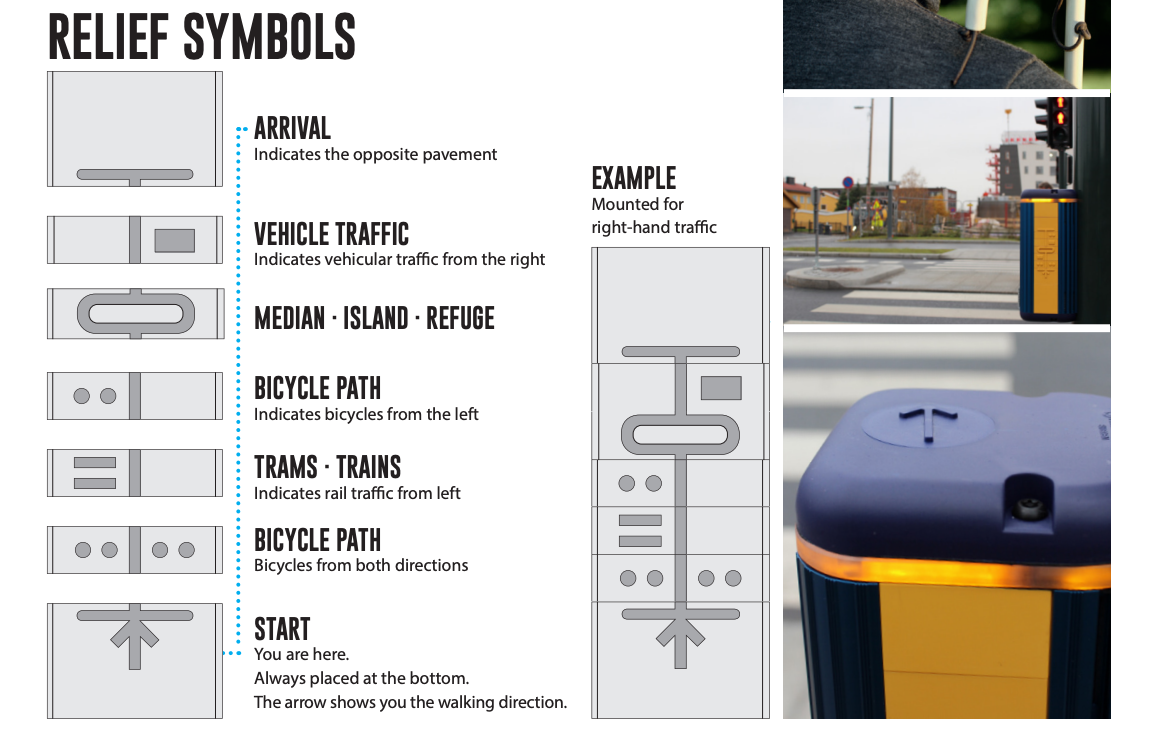
After wandering through Oslo, lunchtime came and I found a McDonald’s. Oslo still felt unfamiliar, so I gravitated toward somewhere at least somewhat familiar. It was my first order in Oslo, and I nervously asked for a burger set and sweet potato fries.


I’d ordered from the kiosk and memorized my number, but the receipt must have been out of ink — it came out completely blank, a white sheet of nothing. A hurdle already, on my very first meal.
When my order came up, I’d need to claim it somehow, but now I couldn’t even show a receipt. I recalled the Norwegian number counting I’d practiced on Duolingo and waited for my order number.
It was 58, I think… Standing there with nothing but a blank receipt in hand, I waited to hear femtiåtte. Fortunately, I caught it and picked up my food as naturally as I could. At last, I had become a proper passerby.
I could cross the crosswalk, and I could collect my food at McDonald’s. What more could I need.