While visiting home during the Lunar New Year holiday, I found a book I had bought around my sophomore year of high school.
The Korean edition is titled How to Solve It - Methods of Mathematical Thinking.
As I recall, I stumbled upon it on the Kyowoo-sa publisher’s website while trying to buy a Calculus violin book.
(The keyword “Kyowoo-sa” triggered the memory.)
At the time, I hadn’t done any research on the book before buying it. I just remember being drawn to the title and vaguely hoping it might help me get better at solving problems.
After that purchase, it sat untouched on my bookshelf.
Nearly ten years later, I finally picked it up again.
There is a Korean edition as well, but the order of Chapter 3 is slightly different. Since the order doesn’t affect the content, it shouldn’t matter much. The English edition has Chapter 3 arranged alphabetically, while the Korean translator seems to have imposed their own semantic ordering. Korean edition link
어떻게 문제를 풀 것인가 | G. 폴리아 저 | 교우사(오판근) - 예스24
이 책에서는 수학 문제의 답을 가르쳐 주는 것보다는 그 문제를 풀고 답이 나올수 있게 하는 수학적 사고 방법에 대해서 설명하고 있다.이 책은 수학을 배우는 사람이나, 수학을 가르치는 사람뿐만 아니라, 자연과학, 인문과학, 사회과학을 배우고 가르치며, 또한 연구...
https://www.yes24.com/Product/Goods/325507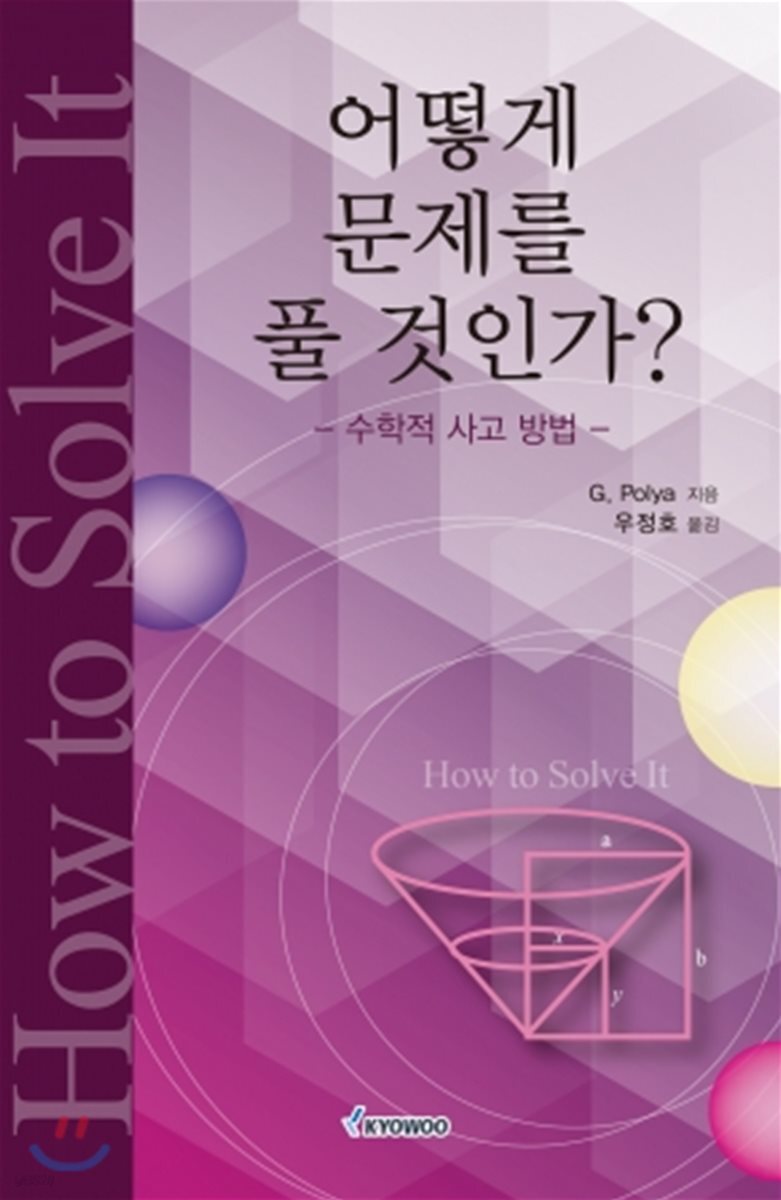
How to Solve It?
I don’t intend to summarize the entire book. That was never the point. I just wanted to write down my thoughts while reading it.
The book’s purpose is primarily pedagogical. On the surface, it may seem to deal only with mathematics, but it presents a methodology for asking questions and finding solutions to problems in general. The goal isn’t simply to find a solution, but to develop problem-solving abilities through the process of generalization and abstraction.
Extending this further, I believe the mathematical thinking methodology presented in this book can also be applied to software development.
The things we encounter while developing, the problems we face — discovering a problem, defining it, and working through solutions follows a methodology similar to mathematical thinking.
Sometimes we don’t even know what the unknown is. Sometimes we lose sight of the goal. Multiple approaches may exist, and we may not know which one is optimal.
In this book, the author approaches problems by asking a series of questions.
In the book, these questions are exchanged between teacher and student, but in the case of development, think of it as a dialogue between you and yourself.
Four Phases
- Understanding the problem
- Identifying connections and devising a plan
- Carrying out the plan
- Reviewing and reflecting on the solution
The book states that sound problem-solving requires going through these four phases.
The example used in the book is finding the length of the diagonal of a rectangular parallelepiped.
Here are the kinds of questions the teacher asks throughout the four phases:
- ‘What is the unknown?’
- ‘What is given?’
- ‘Do you know a related problem?’
- ‘Have you solved a related problem before?’
- ‘What auxiliary element could you introduce to help solve the problem?’
- ‘How can you verify that a step is correct?’
- ‘Can you derive the result by a different method?’
- ‘Can you see it at a glance?’
- ‘Can you apply the result or method to another problem?’
The book also discusses what makes a good question versus a bad one.
In the process of solving the problem above, instead of asking ‘Do you know a related problem?’, one could ask ‘Can you apply the Pythagorean theorem?’ However, the author does not consider this a good question.
Questioning in Problem Solving
The Pythagorean theorem is so concise that it’s easy to memorize and apply. But without understanding why it holds, it becomes difficult to extend it or apply it to other problems. For example, the Pythagorean theorem does not hold in non-Euclidean geometry. Without that deeper understanding, it would be hard to arrive at the question: Why doesn’t the Pythagorean theorem hold in spherical coordinates?
Having only the formula is like how AI interprets images. AI interprets artwork as surface-level pixels — like a kind of orthogonal projection — but Van Gogh’s The Starry Night has an additional dimension: the layered brushstrokes. To understand that, you need to understand the process of painting.
In software development as well, asking questions to solve problems is important. These questions can be directed at yourself or at your colleagues.
The approaches in the book are oriented toward learning, but since development also spans the domain of work, they can’t be applied 100% directly. You can’t invest unlimited time in solving a problem, and you risk losing sight of higher-level objectives. Solving problems for the sake of technical achievement can be a goal in itself, but fundamentally, we solve problems to achieve business objectives.
That said, asking questions to solve problems remains important. Many diverse solutions to the problems we wrestle with already exist out there.
Finding and applying a suitable solution is no easy feat in itself, but I believe it’s important to take time — at least some — to understand the problem yourself and ask questions in pursuit of a solution.
For example, when you encounter a complex component, you might face the problem: How can I reduce this complexity?
Depending on the specific situation, there could be many approaches: compound components, render props, custom hooks, HOC, and so on.
Choosing appropriately among these will certainly help solve the problem more quickly.
Of course, the point isn’t to reinvent the wheel — but behind each of those wheels, someone once asked the right questions.
What I’m trying to say is: if you have the time, take a moment to ask yourself questions. Through that process of solving problems, you might converge on an existing solution, or you might discover something new. Along the way, you’ll also come to understand the purpose and the flow behind how those methodologies were born and evolved.
respice finem
A maxim from the book. In Latin, it means “Before you begin, think of the end.” That is, look at the end. Remember your aim. Do not forget your goal.
As you read through the book, most of it feels like common sense — “well, of course.” But just because something is obvious doesn’t mean we’re actually doing it. I think it’s important to remind ourselves of these things.